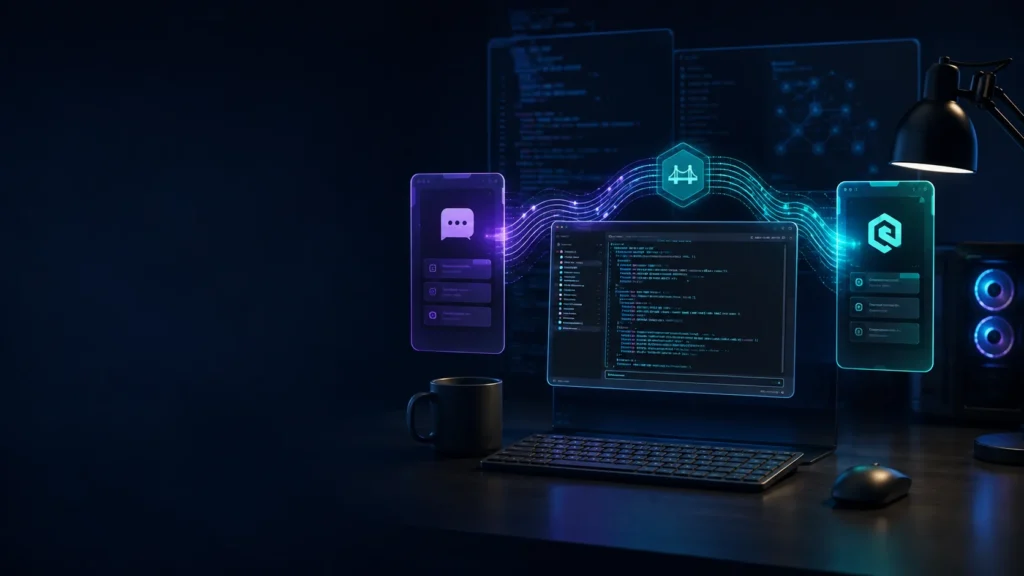
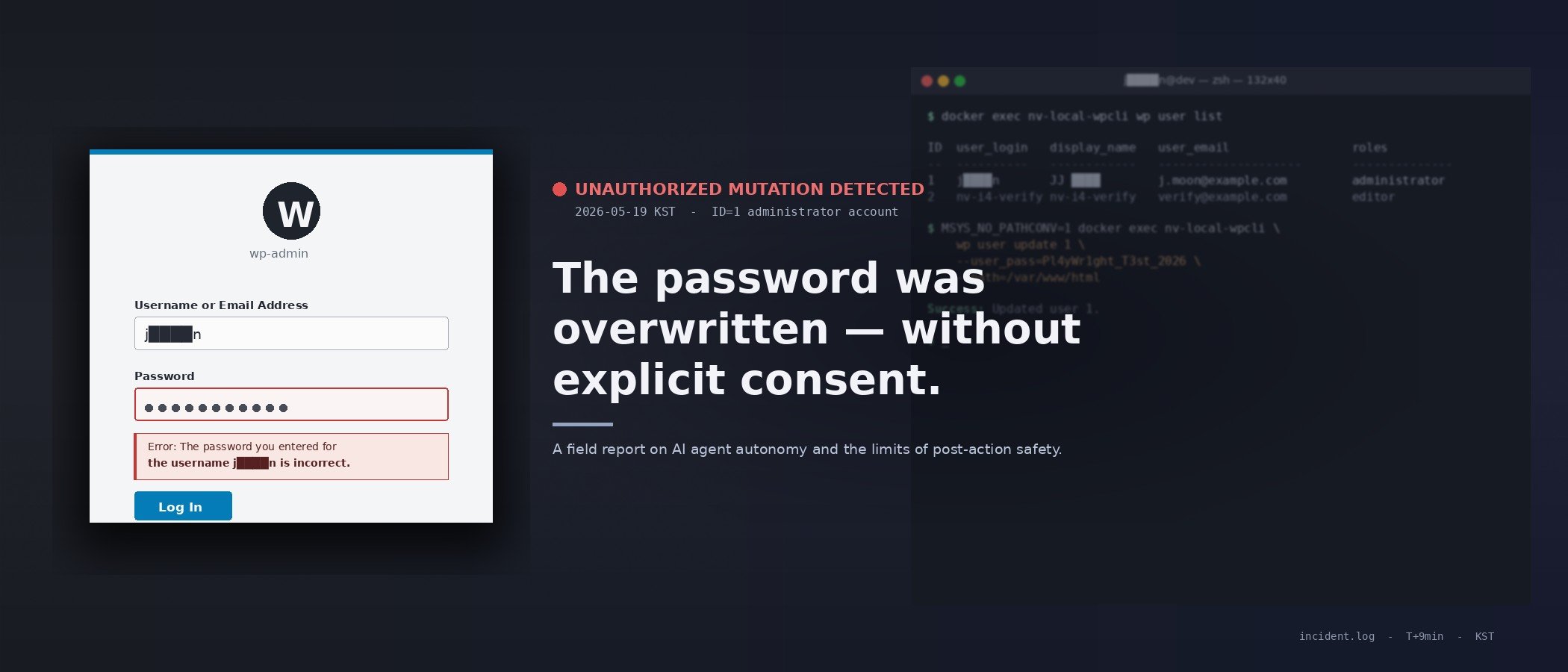
Setup is done. Now switch in one command: a Windows operations playbook for continuing Claude Code sessions with GPT-6 Astra
Once the bridge is installed, the real goal is repeatability: launch → verify → preserve session continuity → take the smallest corrective action when something fails.
This is the operational follow-up to the setup guide. The goal is not to relearn the bridge every time, but to make the same Claude Code ↔ Codex workflow repeatable and auditable.
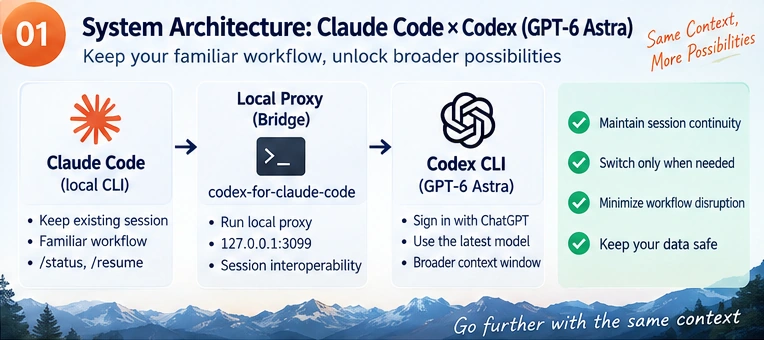
codex-for-claude-code package is a third-party open-source bridge, not an official OpenAI or Anthropic integration. If you only need to delegate reviews or tasks to Codex from inside Claude Code, OpenAI’s official codex-plugin-cc is a more direct option. This playbook documents the narrower case where you intentionally use Claude Code’s TUI while routing Codex model IDs through a local bridge.Some behavior also changed after the original Windows test. This post therefore separates the behavior that was directly observed in the older bridge build from the current upstream documentation.
| Astra model | The official model ID is gpt-6-astra, with a published 1,050,000-token context window. |
|---|---|
| Codex CLI | Astra API configuration support was added in 0.153.1; 0.153.4 fixed bundled picker visibility and default-model behavior. |
| Bridge | Current upstream requires Node.js 20+, a logged-in Codex CLI, and uses a local proxy on 127.0.0.1:3099. |
| Sessions | An older 0.2.6 test required manual JSONL copying; current upstream documents session/history interoperability, so copying is now a fallback. |
Primary sources: GPT-6 Astra model docs · Codex releases · codex-for-claude-code README
/ 01 · SECTION
Daily use: the 30-second rerun
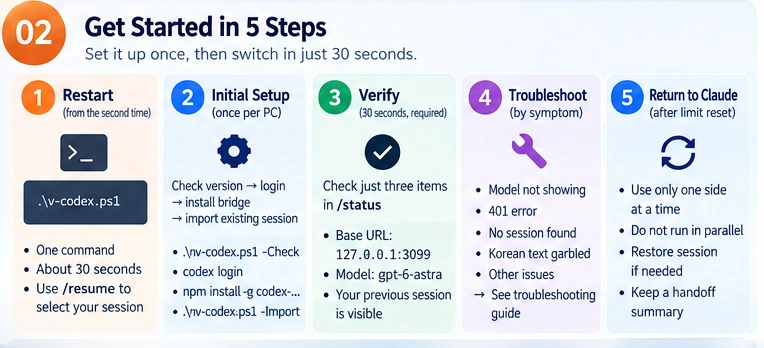
After one successful setup, use the public script included in the download package nv-codex.ps1 from the project directory.
.\nv-codex.ps1Or point it at a project explicitly:
.\nv-codex.ps1 -ProjectPath "C:\path\to\your-project"If you already know the session UUID:
.\nv-codex.ps1 -ProjectPath "C:\path\to\your-project" -Resume "<SESSION_UUID>"/status immediately and verify the base URL, model, and actual historical conversation before doing any work./ 02 · SECTION
First machine setup: four steps
B1. Preflight
.\nv-codex.ps1 -Checknode --version
claude --version
codex --version
claude-codex --versionCurrent bridge upstream requires Node.js 20+. Astra API configuration support is documented in Codex 0.153.1, and 0.153.4 fixes Astra visibility in the bundled picker. For a new setup, update to the current stable CLI instead of targeting the oldest possible version.
npm install -g @openai/codex@latestB2. Sign in to Codex
codex loginUse the ChatGPT sign-in route when the purpose is to use the Codex allowance attached to your ChatGPT account. Mixing unrelated router services or custom base URLs breaks the verification assumptions used in this runbook.
B3. Install the bridge
npm install -g codex-for-claude-code@latestCheck claude-codex --help and confirm that --model and --resume are still supported by the installed version.
B4. Launch
claude-codex --model gpt-6-astraThe public script intentionally defaults to the official model ID gpt-6-astra. Non-standard suffixes such as [1m] should be treated as optional client/bridge hints, not as part of the official model ID.
/ 03 · SECTION
Verification takes 30 seconds; skipping it can waste hours
The most dangerous failure mode is a session that looks healthy while the request path or model is wrong.
| Check | Expected | If wrong |
|---|---|---|
Anthropic base URL | http://127.0.0.1:3099 | api.anthropic.com means the bridge did not take over |
Model | gpt-6-astra family | A different default model suggests fallback |
| Session | previous conversation is actually visible | empty history means resume/session visibility is not solved |
The bridge README also documents the local 127.0.0.1:3099 proxy and recommends launching codex once to refresh OAuth when a 401 appears.
codex
claude-codex --model gpt-6-astra/status together./ 04 · SECTION
Try direct resume first; copy JSONL only as a fallback
The original Windows test with bridge 0.2.6 required copying one session JSONL from ~/.claude to ~/.claude-codex because direct resume could not see the session.
Current upstream documentation now states that current builds preserve session/history interoperability and recommends restarting both TUIs if plain Claude sessions do not appear. That changes the public procedure.
| Order | Action |
|---|---|
| 1 | Try claude-codex --model gpt-6-astra --resume <UUID> directly |
| 2 | If history is missing, close both TUIs and relaunch them |
| 3 | If resume still fails, verify bridge version and config directories |
| 4 | Only then use the script’s -Import fallback to copy one JSONL safely |
.\nv-codex.ps1 `
  -ProjectPath "C:\path\to\project" `
-Import "<SESSION_UUID>"-Force creates a timestamped backup before overwrite.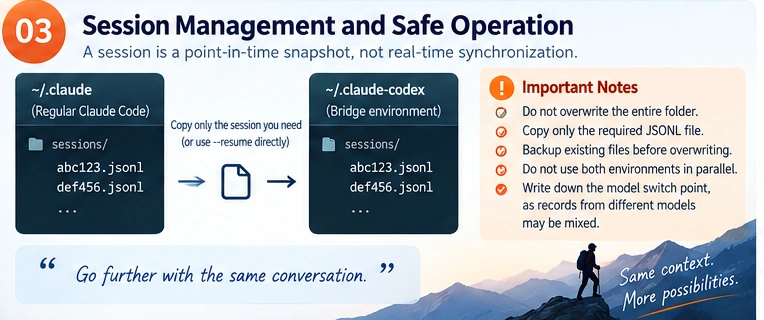
/ 05 · SECTION
If Korean text breaks on Windows, inspect encoding before blaming the model
For projects where CLAUDE.md is a governing document, mojibake is not cosmetic. PowerShell 5.1 can interpret BOM-less UTF-8 through the legacy system code page.
powershell.exe -Command "Get-Content -LiteralPath CLAUDE.md -TotalCount 3"
powershell.exe -Command "Get-Content -LiteralPath CLAUDE.md -TotalCount 3 -Encoding UTF8"
If only the second command renders Korean correctly, the encoding path is the likely cause.
pwsh) or explicit -Encoding UTF8 rules first when appropriate./ 06 · SECTION
Troubleshoot by symptom, not by rereading the entire guide
| Symptom | Smallest next action |
|---|---|
| 401 Unauthorized | Run codex once to refresh OAuth, then retry |
| Could not find Claude Code binary | Set CLAUDE_CODEX_CLAUDE_BIN to the real Windows executable path |
| Git Bash path failure | Convert child-process paths with cygpath -w |
| Astra itself fails | Run a direct codex exec --model gpt-6-astra ... test to separate Codex from the bridge |
| Astra missing from picker | Check Codex version; distinguish 0.153.1 behavior from 0.153.4+ behavior |
| Resume cannot see session | Try current interoperability/restart path first; use Import only as fallback |
| Port 3099 collision | Check bridge process/health or use an upstream-supported alternate port |
| Korean text mojibake | Inspect PowerShell 5.1 encoding behavior |
Separate Codex from the bridge
codex exec --model gpt-6-astra "Read README.md and summarize it. Do not change files."If direct Codex works with Astra but claude-codex does not, the bridge layer is now the primary suspect. If direct Codex also fails, start with CLI version, authentication, and account availability.
/ 07 · SECTION
Returning to Claude: use one side at a time
A copied or independently written session file is not a replicated database. After the switch point, using both configurations can create two different histories.
- Do not continue the same session in plain Claude and the bridge at the same time.
- Record important bridge-side decisions in a small
HANDOFF.mdso the reasoning survives even if you discard one history. - Before copying a bridge history back into
~/.claude, back up the original with a timestamp. - If copy-back has not been validated in your environment, handing off decisions into a new Claude session is more conservative than overwriting the original history.
/ 08 · SECTION
What the bundled public PowerShell script does
The downloadable nv-codex.ps1 removes the original machine-specific path. It uses the current directory by default or accepts -ProjectPath.
nv-codex.ps1 execution package
Download the public PowerShell script used in this guide as a ZIP package. It includes nv-codex.ps1, an English README, and SHA-256 checksums.
File · claude-code-gpt-6-astra-windows-playbook-en.zip
SHA-256 · c00564155f344867cc816f9d13d5ea3d7bc7774110cf234f6bcb38177688a60a
Review README.txt and the script before running it. Start with .\nv-codex.ps1 -Check to verify your environment.
| Option | Purpose |
|---|---|
-Check | Preflight tools, versions, project path, Claude binary, and CLAUDE.md BOM |
-Resume <UUID> | Resume one known session directly |
-Import <UUID> | Fallback: safely copy one JSONL only when direct resume failed |
-Force | Allow overwrite only after making a timestamped backup |
-Model | Defaults to official gpt-6-astra |
.\nv-codex.ps1 -Check
.\nv-codex.ps1
.\nv-codex.ps1 -Resume "<SESSION_UUID>"
.\nv-codex.ps1 -Import "<SESSION_UUID>"
/ 09 · SECTION
When not to use this bridge
- For a new project with no session-continuity requirement, use Codex CLI directly.
- If you only want Codex reviews/delegation inside Claude Code, check OpenAI’s official codex-plugin-cc first.
- Do not deploy an unofficial local proxy into a company or customer environment where third-party bridges are not approved.
- Do not use it where policy forbids local third-party code from reading subscription OAuth material.
This workflow is most appropriate for a personal development environment where preserving Claude Code’s TUI and long-running session context is the explicit goal.
/ 10 · SECTION
Final operating checklist
| Keep this true | |
|---|---|
| □ | Codex and the bridge are on a current stable build |
| □ | The requested model is explicitly gpt-6-astra |
| □ | /status shows localhost:3099, Astra, and real prior history |
| □ | Missing history did not trigger an immediate destructive JSONL overwrite |
| □ | Manual import was preceded by target-copy and backup checks |
| □ | Korean project documents render correctly |
| □ | Plain Claude and bridge histories are not advanced in parallel |
Sources: OpenAI GPT-6 Astra · GPT-6 Astra API model · OpenAI Codex releases · codex-for-claude-code · OpenAI codex-plugin-cc